What Is an AFE and Why Does It Matter?
An Authorization for Expenditure (AFE) is the financial blueprint for a well. Before any drilling begins, the operator prepares an AFE that estimates every cost category: drilling, completion, facilities, geological and geophysical work, surface equipment, and overhead. The AFE is submitted to working interest partners for approval and, once authorized, serves as the budget against which actual costs are tracked.
The AFE isn't just a budget — it's a commitment. Working interest partners are financially obligated once they approve an AFE. The operator is accountable for managing costs within the authorized amount, and any significant overrun requires a supplemental AFE with additional partner approval.
For operators managing dozens or hundreds of wells, AFE tracking is central to financial control. Each well has its own AFE, its own budget, and its own set of actual costs rolling in from vendors, service companies, and internal allocations. The ability to see — in real time — where each well stands relative to its AFE is what separates disciplined operators from those who discover cost overruns only at month-end close.
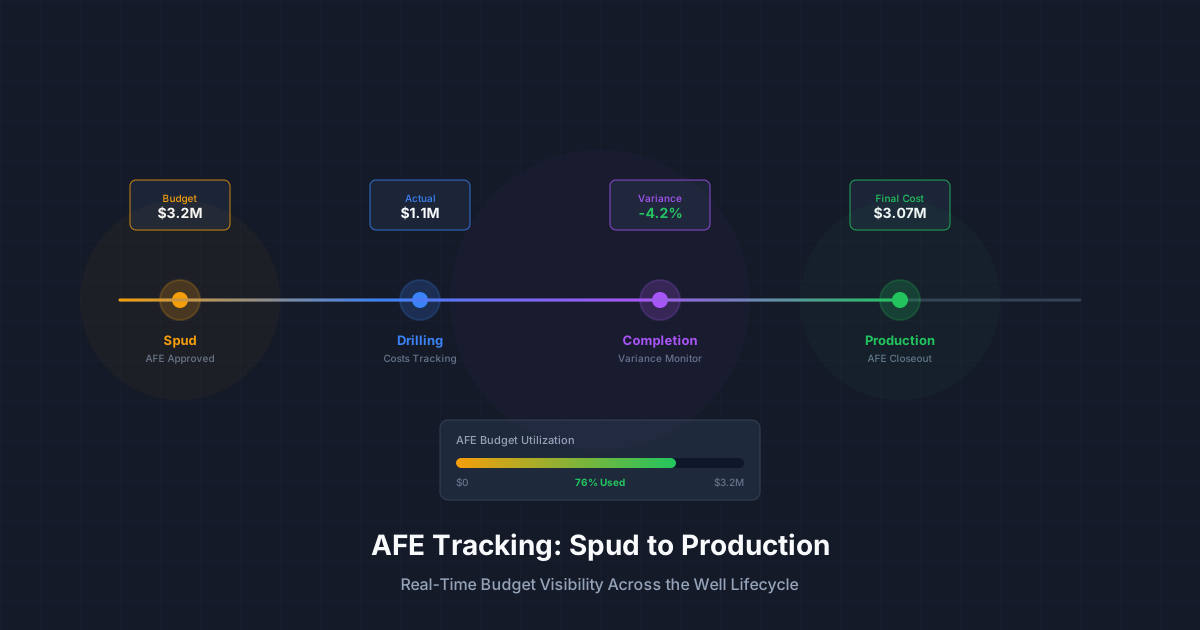
The AFE Lifecycle: From Estimate to Closeout
The AFE lifecycle begins with the estimate. A reservoir engineer or drilling engineer builds the cost estimate using offset well data, vendor quotes, and operational assumptions. The estimate is structured by AFE cost categories — typically following the Council of Petroleum Accountants Societies (COPAS) coding structure — and broken down by tangible and intangible costs for tax purposes.
Once the estimate is complete, the AFE enters the approval workflow. It's routed to internal management for review, then sent to working interest partners. Partners have a defined period to approve, reject, or elect to go non-consent. The approval process often involves negotiations over scope, budget, and operational approach.
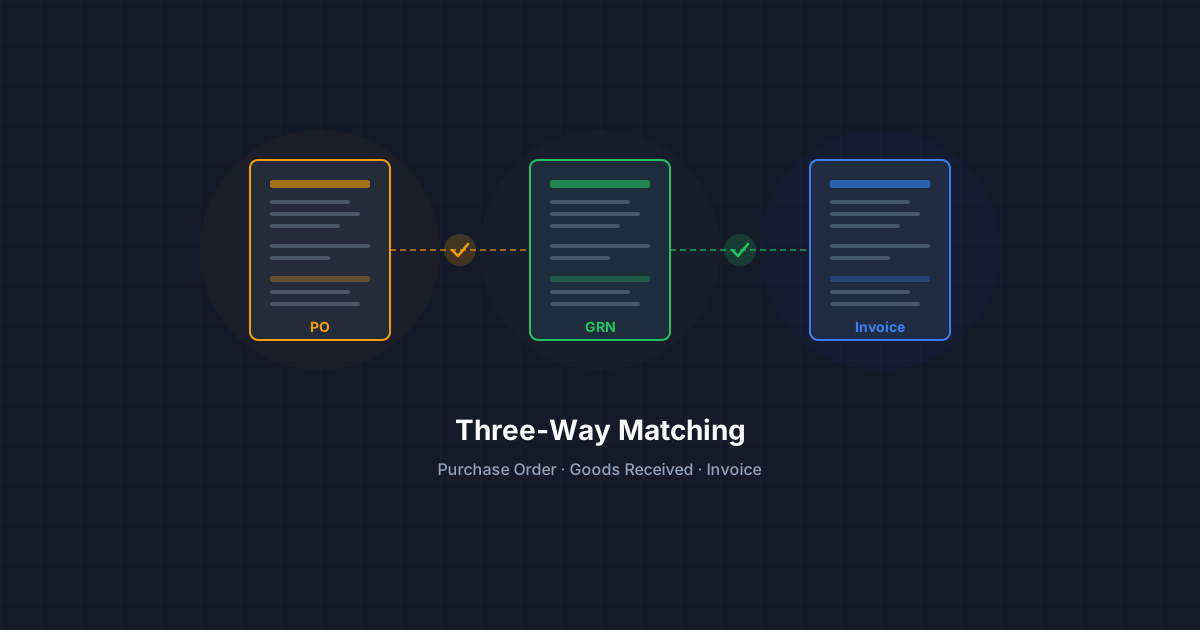
After approval, the AFE becomes the active budget. Costs begin accumulating as the well is drilled and completed. Purchase orders are tied to the AFE, vendor invoices are coded against AFE line items, and daily cost reports show the cumulative spend versus the authorized budget.
At the end of the well's drilling and completion phase, the AFE is closed out. Actual costs are compared to the original estimate, variances are analyzed, and joint interest billings are finalized with partners. The closeout data feeds into the operator's database for future well planning.
Tracking Costs in Real Time
The traditional approach to AFE tracking involves a monthly reconciliation cycle. Costs accumulate in the accounting system, someone pulls a report at month-end, and management sees where things stand. By the time a cost overrun is identified, weeks have passed and the well may already be at total depth.
Real-time AFE tracking changes this dynamic. When purchase orders, field tickets, and vendor invoices are processed through an integrated system, the AFE budget is updated immediately. A drilling superintendent can open a dashboard and see — right now — that the well is 15% over budget on drilling fluids and 8% under on directional services.
This real-time visibility enables proactive cost management. If mud costs are trending over budget, the drilling engineer can evaluate alternative formulations before the overrun grows. If casing costs came in under budget, that surplus can offset overages in other categories without triggering a supplemental AFE.
Daily cost summaries sent to key stakeholders keep everyone aligned. The operator's management, the drilling superintendent, and the working interest partners all see the same numbers. Surprises at month-end become rare when everyone has access to the same real-time data.
Managing AFE Variances
No well comes in exactly on budget. The question is whether variances are identified early and managed proactively, or discovered late and explained retroactively.
Effective AFE tracking systems flag variances at the line-item level, not just the total. A well might be on budget overall, but individual categories could be significantly over or under. Drilling costs might be favorable because the well drilled faster than expected, while completion costs are unfavorable due to an unplanned workover. The total looks fine, but the category-level detail tells a more nuanced story.
Threshold-based alerts notify the right people when a category exceeds a defined percentage of its budget. A 10% overrun on a small line item might not warrant attention, but a 10% overrun on the largest cost category — say, drilling rig charges — requires immediate review.
Variance analysis at closeout feeds the estimation process for future wells. If the operator consistently underestimates completion costs on a particular formation, that pattern should be reflected in future AFEs. Over time, estimation accuracy improves, partner confidence increases, and the need for supplemental AFEs decreases.
Joint Venture Partner Reporting
For operators managing wells with multiple working interest partners, AFE tracking is directly tied to joint venture accounting. Each partner's share of the well costs is determined by their working interest percentage, and the operator is responsible for billing partners accurately and on time.
Cash calls — advance billings sent to partners before costs are incurred — are based on the AFE estimate. As actual costs come in, the operator issues joint interest billings (JIBs) that true up the advances. Discrepancies between estimates and actuals require adjustment billings.
Partners have audit rights under most joint operating agreements. They can (and do) review the operator's cost allocations, verify that charges are coded to the correct AFE, and challenge costs that appear unreasonable. An operator with clean, well-documented AFE tracking is better positioned to defend costs during a partner audit.
Transparent reporting builds trust with partners. When an operator can share real-time AFE dashboards with working interest partners — showing exactly where costs stand against the budget — it demonstrates competence and accountability. Partners are more likely to approve future AFEs from operators with a track record of accurate estimation and transparent reporting.
From Tracking to Intelligence
The most valuable outcome of disciplined AFE tracking isn't cost control on any single well — it's the database of cost history that accumulates over time. Every closed-out AFE adds to the operator's knowledge base: what things actually cost, which vendors deliver on price, which formations are more expensive to drill, and which operational decisions lead to cost overruns.
This historical data powers better decision-making. When planning a new well, the operator can pull cost data from offset wells in the same field, adjust for current pricing, and build an AFE estimate grounded in actual experience rather than vendor quotes alone.
Benchmarking across wells, fields, and time periods reveals trends that aren't visible at the individual well level. If drilling costs per foot have increased 12% year-over-year in a particular basin, that trend should inform both future AFEs and negotiations with drilling contractors.
The transition from AFE tracking to AFE intelligence is what separates operators who manage costs from those who merely record them. The data is the same — it's the analysis and application that makes the difference.